
DECONSTRUCTING IDENTITY
Oct 22, 2026 - Dec 5, 2026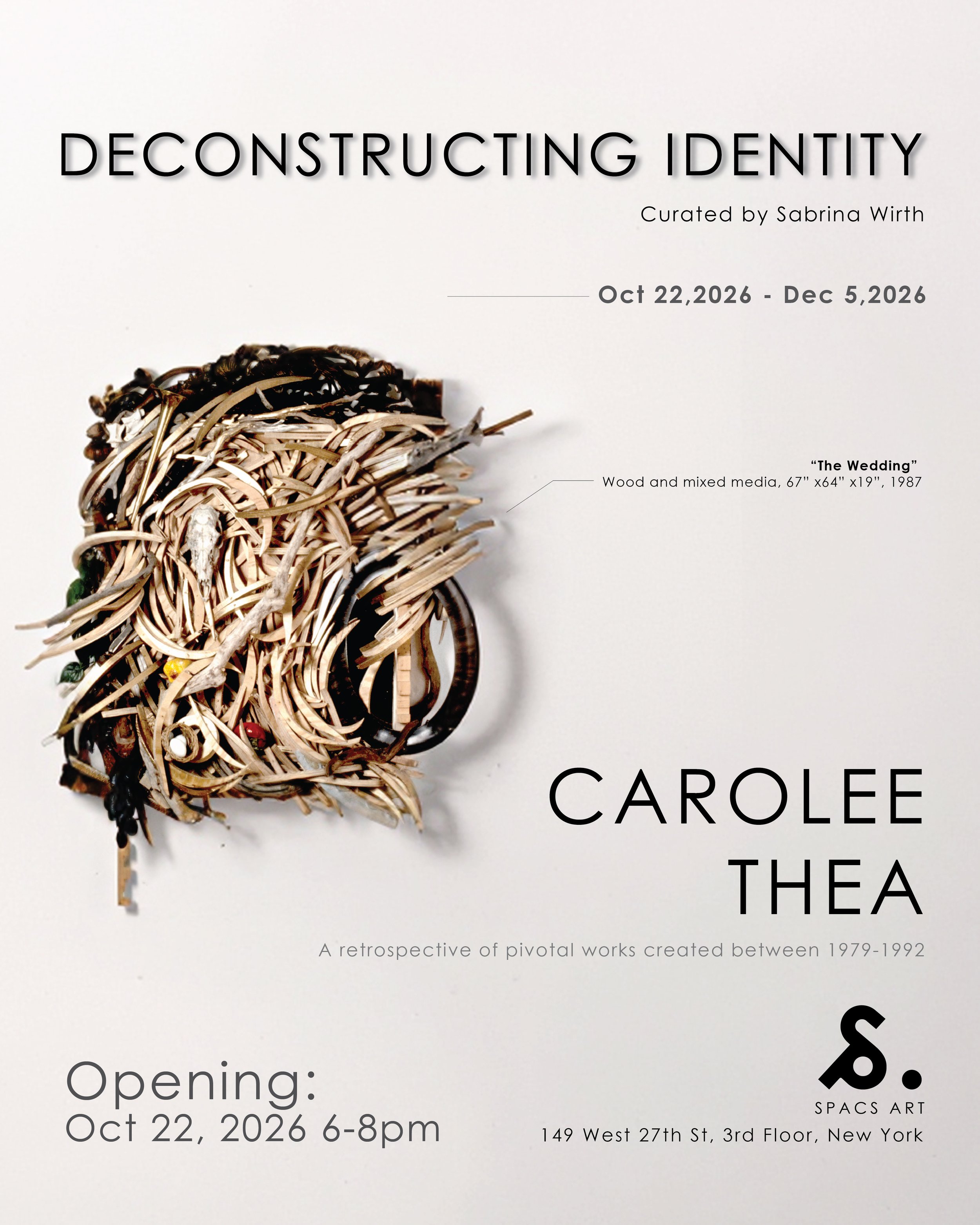
SPACS Gallery presents Deconstructing Identity, an exhibition of work by New York artist, writer and curator Carolee Thea, curated by Sabrina Wirth and on view October 22 through December 5, 2026. Coinciding with the launch of Thea's forthcoming memoir “A Scheme to Annihilate Magnificent Distances”, the exhibition brings together her Constructed Paintings, sculpture and installation work that has not been publicly seen since in three decades. offering a timely reconsideration of an artistic practice that developed out of New York's experimental art scene beginning in the 1970s.
Long before questions of gender, authorship and the politics of space became central to contemporary art discourse, Thea was exploring them materially. Rejecting conventional boundaries separating painting from sculpture and artwork from environment, she incorporated wood, bone, rubber and other found materials into assemblages that pushed beyond the frame and into physical space. Her House Series (1979-1985), in particular, transformed painting into something simultaneously pictorial and architectural. The frame became a recurring point of departure. Rather than treating it as a passive boundary around an image, Thea activated it as part of the work itself. Lines escape their confines and materials project outward, allowing painting to enter the viewer's physical space. As critic John Yau wrote of Thea's constructions, the frame functions both as a "scaffold and a shallow container," becoming a means through which the artist could examine the social dynamics that inform the way we look at painting.
Thea's formal experimentation was inseparable from her politics. An ardent feminist, she developed her practice amid the social and artistic revolutions that reshaped New York in the 1960s and 1970s. While artists such as Robert Rauschenberg and Jasper Johns had challenged the boundaries between painting and sculpture, Thea connected her own formal investigations to the personal and political. Breaking the frame became not simply a formal gesture, but a means of examining agency and the structures surrounding the female body. Her investigation eventually moved beyond the gallery wall altogether. Following her inclusion in the 1984 Bard College exhibition Landmarks, which presented proposals by twenty-two pioneering environmental artists, Thea developed Daphne, inspired by the mythological figure who transforms herself into a tree to escape Apollo. The project initiated an exploration of sculptural figuration that included papier-mache figures modeled in part on Thea's own choreographed movements as a former dancer. Positioned on thin poles or wheels rather than conventional pedestals, the figures seem capable of movement, challenging the traditional conception of the sculptural body as something fixed or contained.
Seen four decades later, these works feel strikingly contemporary. Deconstructing Identity places them within the cultural environment in which they were made while considering how many questions artists are grappling with today were already being explored by women working outside the dominant narratives of their time. The exhibition also brings together two chapters of Thea's career that have often been considered separately. Alongside her studio practice, she began writing in 1976 as a member of the editorial board of Heresies V, a feminist publication devoted to art and politics. Over the following decades, writing and curatorial research became another extension of her artistic life. Thea went on to become an important chronicler of the transformation of contemporary curating. Her three-volume series of interviews with international curators documented the emergence of an increasingly global art world through conversations with figures including Okwui Enwezor, Hans Ulrich Obrist, Carolyn Christov-Bakargiev, Massimiliano Gioni and RoseLee Goldberg. Foci: Interviews with 10 International Curators appeared in 2001, followed by On Curating / Interviews with 10 International Curators in 2009 and On Curating 2 // Paradigm Shifts in 2016.
Her archive of original interviews was acquired by the Bard Center for Curatorial Studies and the Hessel Museum of Art's Library and Archives in 2012. The publication of Scheme to Annihilate Magnificent Distances now turns the focus toward Thea's own history. Launched in conjunction with the exhibition, the book provides an occasion to consider her roles as artist and writer not as separate identities, but as parts of a continuous practice shaped by a persistent questioning of established structures.
Together, the exhibition and book bring Thea's artistic practice back into view, creating an opportunity for a new generation to encounter work that has lost little of its urgency.
ABOUT CAROLEE THEA
Carolee Thea is an artist, writer, curator and art critic whose career spans more than five decades. As a multimedia artist, her work has appeared in numerous solo and group exhibitions. She received an award from the National Endowment for the Arts in 1990 and an award from the Athena Foundation for her work at Socrates Sculpture Park in 1988.
Her writing has appeared in Parkett, Artforum.com, Artnet, BOMB, ArtAsiaPacific and The Brooklyn Rail, among other publications, and she has served as a contributing editor to ArtAsiaPacific and Sculpture Magazine.
Thea received her B.A. from Columbia University and her M.A. from Hunter College. She was invited to the American Academy in Rome as a Distinguished Visiting Scholar in 2004 and selected as the Gund Visiting Curator at Hunter College in 2017.